

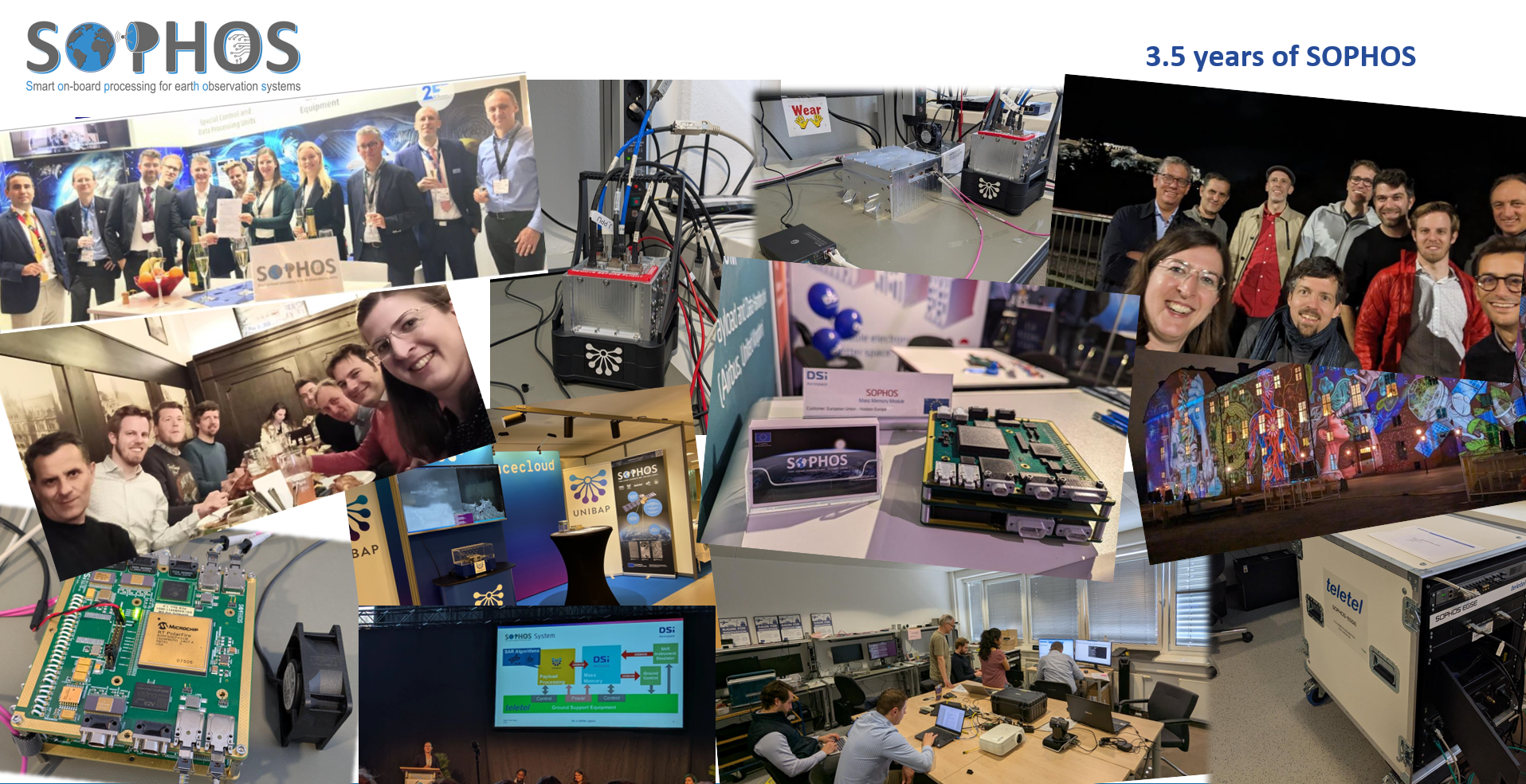
The SOPHOS project successfully concluded its final review on March 25. Consortium partners gathered at the lead partner’s DSI premises in Bremen to finalize the project with a live demonstration of the system.
As thousands of satellites now orbit Earth, generating ever-growing amounts of data from applications like Synthetic Aperture Radar (SAR), the demand for efficient on-board processing and storage has become critical due to limited downlink availability. SOPHOS addressed this challenge by designing enabling technology for high-end data products produced directly on spacecraft, focusing on power-efficient, high-performance processing chains for Low-Earth Orbit (LEO) missions.
The core of the solution is the SOPHOS demonstrator, which integrates a Payload Processing Module (PPM), a Mass Memory Module (MMM), and Electronic Ground Support Equipment (EGSE). This system employs a mixed-criticality design: the MMM utilizes qualified, radiation-tolerant devices for reliable long-term storage, while the PPM leverages state-of-the-art Commercial Off-The-Shelf (COTS) components for high-volume in-orbit computing. High-speed data transfer is managed via 10G Ethernet interfaces, with command and control handled through SpaceWire. A key innovation is the high-speed routing function within the MMM, allowing flexible data handling such as online or offline processing and raw data replay to the ground segment. The hardware modules were designed to fit SmallSat form factors, enhancing their applicability in the commercial space domain.
Significant improvements were made in SAR raw data compression using an optimized block adaptive quantizer (PO-BAQ), achieving a speedup of approximately 300 in stand-alone tests. Additionally, a wavenumber domain algorithm for SAR image formation was developed and functionally validated. The resulting modular and agile architecture offers new possibilities for reducing bandwidth needs and delivering more data from intensive earth observation applications.
